
- Home
- Services
- Kitchen, Bath & Remodeling
- Bathroom Remodeling
Bathroom remodeling in Marin County and the Bay Area
MM Bay Construction & Restoration remodels bathrooms across Marin County and the Bay Area, from a new vanity and tile to a full gut and layout change, under our CSLB general building license. We answer 24/7, and we build showers the way a water damage contractor would: to keep water where it belongs.
- Answered 24/7
- Licensed contractor · CSLB #1071905
- We bill your insurance
- Dry-out to rebuild, one company
- 24/7, every dayPhones answered, crews sent
- Licensed & bondedCA General Building, CSLB #1071905
- Insurance billed directlyWe work with your adjuster
- We do the rebuild tooHomes, businesses, multifamily
Signs you need bathroom remodeling
- Cracked grout, loose tile or caulk that keeps failing
- A stain on the ceiling below the bathroom
- A soft floor around the toilet or tub
- A tub you want to convert to a walk-in shower
- Poor ventilation, peeling paint or mold on the ceiling
Showers fail behind the tile
Tile and grout are not waterproof. Grout is porous, and water passes through it every time the shower runs. What keeps the wall and floor dry is the waterproofing layer behind the tile, and when a shower leaks into the room below or rots the subfloor, that layer is almost always the reason.
We build showers with a continuous waterproof system. On the floor, that can be a traditional mortar bed over a sloped liner, or a modern bonded membrane over a pre-sloped base. On the walls, it is a sheet or liquid-applied membrane over cement board or a waterproof backer, lapped into the pan so there is no gap. The floor slopes evenly to the drain, the curb is waterproofed on all sides, and niches and benches, the most common failure points, are built with sloped tops and fully membraned corners. Before tile goes on, we flood test the pan by plugging the drain and filling it with water, then checking that the level holds. Many building departments inspect the pan as well.
Ventilation, so the next problem is not mold
A bathroom produces a lot of moisture every day, and where it goes decides whether the ceiling stays clean. In the remodels and restoration jobs we see, a common problem is an exhaust fan that is too small, too loud to use, or ducted into the attic instead of outdoors, which puts warm, damp air right against the roof sheathing.
For new bathrooms with a shower or tub, California's green building code calls for an Energy Star exhaust fan ducted to the outdoors, with a humidity control. We install the same in remodels, because a fan that turns itself on when humidity rises solves the problem of people forgetting to run it. The duct runs to an exterior wall or roof cap with as few bends as possible, and the fan is sized for the room. In foggy neighborhoods, where outside air is often damp, a properly running fan matters even more. We also use moisture-resistant board and paint on ceilings, and repair any existing mold before the new bathroom goes in.
Walk-in showers and bathrooms that work for the long run
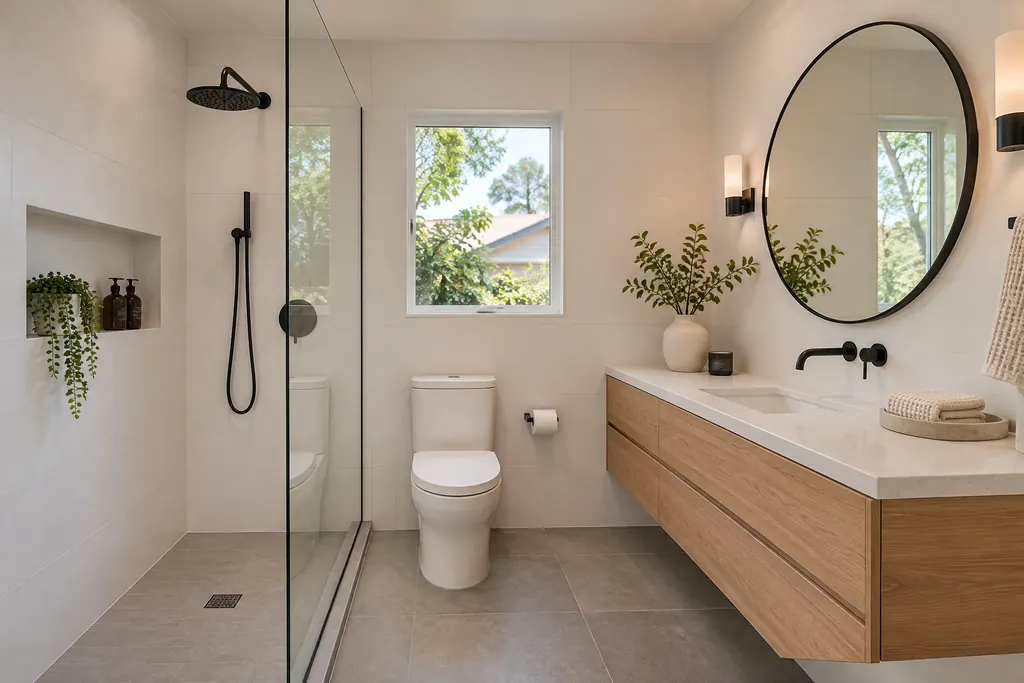
Many bathroom remodels are about access: replacing a tub with a walk-in shower, lowering a curb, or going fully curbless. A curbless shower needs the shower floor to be lower than the bathroom floor so it can slope to the drain. In homes on raised foundations, that can mean recessing the floor framing under the shower, which is structural work done under permit. On a slab, it can mean cutting and lowering the concrete. Both are routine for a general contractor and both should be planned before tile is chosen.
While walls are open, we add solid blocking behind the tile and drywall wherever grab bars might ever go, so they can be installed later without searching for studs. Other choices make a bathroom easier to use for years: a comfort-height toilet, a handheld shower on a slide bar, a bench, a wider door, lever handles and good lighting. If the existing floor is soft, our subfloor and framing repair work comes first.
What we do, step by step
Plan the layout
We measure, talk through what you want and settle the layout and fixtures.
Selections
Tile, vanity, fixtures, glass and lighting are chosen and ordered.
Demolition and inspection
The old bathroom comes out, and framing and subfloor are checked for leak damage.
Rough-in
Plumbing, electrical and fan ducting, inspected under permit when required.
Waterproof and test
Backer board, membrane and pan, then a flood test before any tile.
Tile and finish
Tile, vanity, toilet, fixtures, glass, paint and a final walkthrough.
After the cleanup, we put it back
A bathroom remodel often starts with a leak: a shower pan that seeped into the subfloor, or a toilet seal that rotted the floor around it. Since MM Bay handles the rot repair and the remodel as one job, the structure gets fixed before new tile goes down, instead of being discovered halfway through by a tile setter who cannot repair framing. The result is a new bathroom built on a sound, dry floor.
Repairs & reconstruction
How insurance usually handles this
Insurance may cover part of a bathroom remodel when it follows a sudden leak, like a burst supply line behind the wall. A shower that leaked slowly for months is usually treated as wear and tear, though some policies cover the resulting damage. When a claim pays to restore the bathroom, anything beyond like kind and quality, such as a larger shower or better tile, is the owner's cost. We keep the two scopes on separate lines.
Bathroom Remodeling: questions we hear
Still have a question? Call (415) 878-3410. We pick up 24/7.
How long does a bathroom remodel take?
Construction for a typical full bathroom remodel often runs a few weeks, plus time for selections, permits and any special-order items like custom glass or vanities. Rot repair or a layout change adds time. A cosmetic update, like a new vanity and toilet, can be much quicker. We give you a written schedule before demolition.
Can you convert a tub to a walk-in shower?
We can, and it is one of the most common bathroom remodels. The tub comes out, the drain is moved or adapted, and a new waterproofed shower is built in its place, with a low curb or curbless entry. Curbless showers may need the floor framing or slab lowered, which we plan and permit.
What is the best waterproofing for a shower?
There is no single best product, but there is a best approach: a continuous waterproof layer on the floor and walls, lapped together with no gaps, over a floor that slopes evenly to the drain, then flood tested before tile. Traditional mortar beds with liners and modern bonded membranes both work when installed correctly.
Why does my bathroom ceiling keep getting mold?
Usually because moisture from showers has nowhere to go. A fan that is too small, too noisy to use, or vented into the attic leaves the ceiling damp after every shower. A properly sized fan ducted outdoors with a humidity control usually solves it, after the existing mold is removed and the ceiling repaired.
Often needed together
Framing & Subfloor Repair
Rotted joists, subfloors, sill plates and wall framing repaired or replaced after leaks and long-term moisture.
Kitchen Remodeling
Cabinets, counters, layouts, lighting and plumbing, built under one CSLB license, including upgrades during a rebuild.
Mold Inspection & Testing
Moisture-focused mold inspections, with independent lab testing coordinated when it answers a real question.
More remodeling services
Water where it shouldn’t be? We’re ready now.
Call any time, day or night. We’ll tell you what to do right away and send a crew.