
- Home
- Services
- Repairs & Reconstruction
- Flooring Replacement
Flooring repair and replacement after water damage in the Bay Area
MM Bay Construction & Restoration repairs and replaces water-damaged hardwood, tile, carpet, vinyl and laminate floors across Marin County and the Bay Area. We answer 24/7, check the subfloor before anything new goes down, and match or blend the new flooring into what you already have.
- Answered 24/7
- Licensed contractor · CSLB #1071905
- We bill your insurance
- Dry-out to rebuild, one company
- 24/7, every dayPhones answered, crews sent
- Licensed & bondedCA General Building, CSLB #1071905
- Insurance billed directlyWe work with your adjuster
- We do the rebuild tooHomes, businesses, multifamily
Signs you need flooring replacement
- Hardwood boards cupping, crowning or gapping
- Vinyl plank or laminate lifting at the seams
- Loose or hollow-sounding tiles after a leak
- Carpet that stays damp or smells musty
- A soft or bouncy spot in the floor
Hardwood: dry it, sand it, or weave in new boards
Wet hardwood cups: the edges of each board rise above the center because the bottom absorbed more water than the top. Many cupped floors flatten as they dry, especially with drying mats that pull moisture up through the boards. The mistake is sanding too soon. Sand a cupped floor flat while it is still wet underneath, and as it finishes drying the centers end up higher than the edges, which is called crowning.
Once the readings confirm the floor is dry, we decide what it needs. A floor that flattened may only need sanding and refinishing. Boards that split, delaminated or stayed cupped are cut out and replaced by weaving new boards into the existing floor in a staggered pattern, so there is no straight seam. Then the whole room is sanded and refinished so old and new boards take the same stain and finish. Many mid-century Bay Area homes have 2 1/4 inch oak strip flooring, and older homes often have fir or narrower oak, so we match species, width and grade. A floor that has been sanded many times may be too thin to sand again, which we check before recommending it.
Vinyl plank, laminate, tile and carpet each fail differently
Luxury vinyl plank and laminate are usually installed as floating floors, clicked together over the subfloor. The vinyl plank itself shrugs off water, but water runs underneath and gets trapped, so planks have to come up for the subfloor to dry. Laminate has a fiberboard core that swells and does not go back. Because a floating floor often runs continuously through several rooms, replacing one section can mean pulling up the whole connected area or adding a transition strip at a doorway. Matching is harder still when the product has been discontinued.
Tile is waterproof, but the grout, the mortar and the subfloor under it are not. Tile over a wood subfloor can loosen as the wood swells and shrinks. We tap-test for hollow tiles, dry what we can through the grout joints, and replace loose sections. Carpet wet by clean water can often be dried and reinstalled over new pad. Carpet touched by gray or black water is replaced.
The subfloor comes first
New flooring is only as good as what is under it. Before anything goes down, we check the subfloor's moisture and flatness. Flooring manufacturers set limits for subfloor moisture before installation, and installing over a wet subfloor can void their product warranty and lead to gaps, cupping or adhesive failure later.
Wood subfloors vary by age. Older Bay Area homes often have diagonal board sheathing, newer ones plywood or OSB. OSB tends to swell at the edges and stay swollen, and plywood can delaminate. Damaged sections are cut out to the joist centers and replaced, then screwed down to stop squeaks and sanded or leveled at the seams. Concrete slabs get moisture testing before any glue-down floor, and a moisture barrier when the readings call for one. Bigger subfloor and joist problems are covered on our framing and subfloor repair page.
What we do, step by step
Assess and dry
We measure the flooring and subfloor and dry what can be saved.
Identify the floor
Species, width, product line and installation method are recorded for matching.
Check the subfloor
Moisture, flatness and damage are checked before new flooring is ordered.
Remove and prepare
Damaged flooring comes out, the subfloor is repaired, screwed down and leveled.
Install or weave in
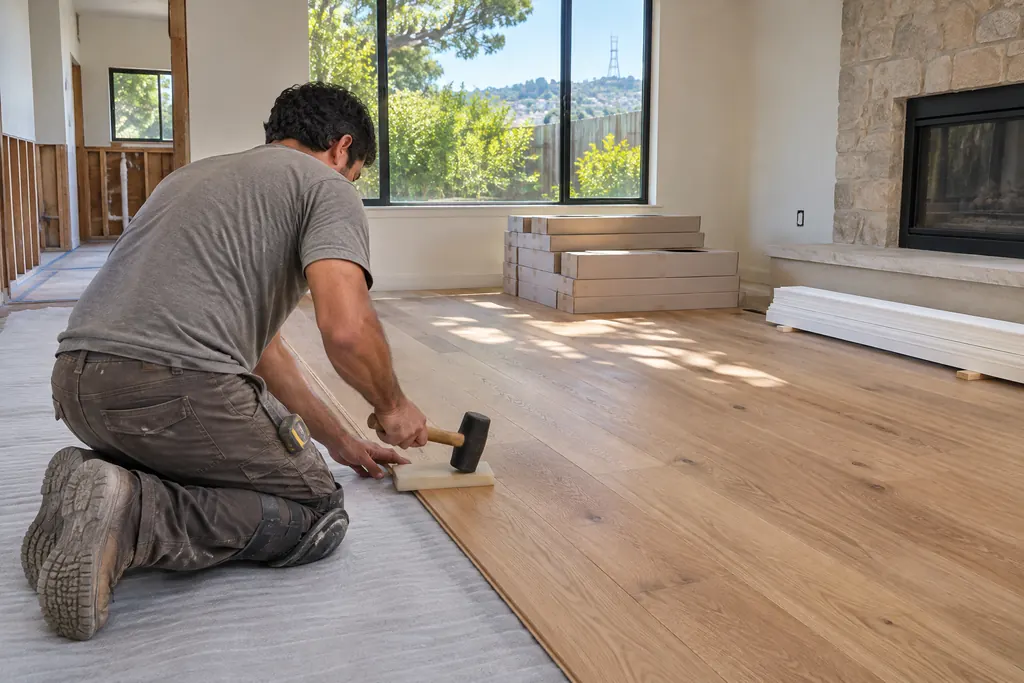
New flooring is installed, or new boards are woven into the existing floor.
Finish and transition
Sanding and refinishing, thresholds, and baseboards reinstalled over the new floor.
After the cleanup, we put it back
Flooring is often the last trade in and the first thing people notice. Since MM Bay also handles the drywall, cabinets and trim, we plan the order so floors go in after the dusty work is done, cabinets sit at the right height, and baseboards go back over the new floor. When a floor runs through several rooms, we look at the whole run during mitigation, so the decision to repair or replace is made with the finished house in mind.
Repairs & reconstruction
How insurance usually handles this
Installed flooring falls under your dwelling coverage, and it is where depreciation shows up most. Carpet and vinyl wear out, so an adjuster may depreciate an older floor and pay its actual cash value first, releasing the rest after replacement on a replacement cost policy. We record the floor type, age, condition and product details with photos, so the estimate reflects what you actually had, not a generic line item.
Flooring Replacement: questions we hear
Still have a question? Call (415) 878-3410. We pick up 24/7.
Will insurance pay to replace my whole floor if only part got wet?
It depends on whether the repaired section can match. California's Fair Claims Settlement Practices Regulations say that when replacement items do not match in quality, color or size, the insurer must replace all items in the damaged area for a reasonably uniform appearance. What counts as the area can be debated, so we document the product, layout and matching options for your adjuster.
Can water-damaged hardwood floors be saved?
Often. Solid hardwood wet by clean water and dried promptly can usually be flattened, sanded and refinished. Boards that split, stayed cupped or were wet by contaminated water are replaced by weaving in new boards. Engineered hardwood is less forgiving, because its thin top layer can delaminate and may not allow much sanding.
Can you match my existing hardwood floor?
Usually. We match the species, board width and grade, weave the new boards into the existing floor, and refinish the whole room so the color reads as one surface. Older fir and narrow oak floors take more searching for matching boards, and sometimes salvaged boards from a closet are used for the most visible areas.
Does vinyl plank flooring need to be removed after a leak?
Usually. The planks are waterproof, but water gets trapped underneath on the subfloor and will not dry with the floor in place. Planks can sometimes be removed carefully and reinstalled after the subfloor dries, depending on the locking system and condition. If they cannot, we look for the same product or plan a clean transition.
Often needed together
Framing & Subfloor Repair
Rotted joists, subfloors, sill plates and wall framing repaired or replaced after leaks and long-term moisture.
Structural Drying
Moisture mapping, dehumidifiers and daily readings until walls, floors and framing are verified dry.
Appliance & Water Heater Leaks
Cleanup after water heater, dishwasher, washer and ice-maker line failures, plus cabinet and floor repairs.
More reconstruction services
Water where it shouldn’t be? We’re ready now.
Call any time, day or night. We’ll tell you what to do right away and send a crew.